






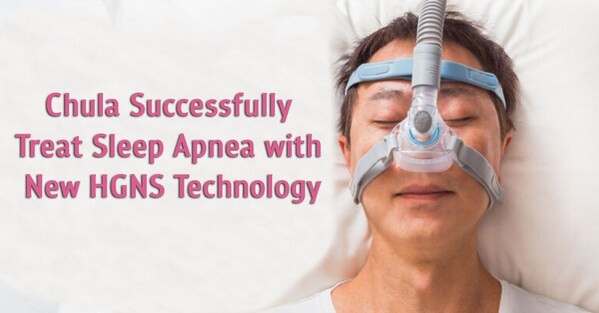
BANGKOK, April 22, 2026 /PRNewswire/ — The Excellence Center for Sleep Disorders, King Chulalongkorn Memorial Hospital, Thai Red Cross Society has successfully performed surgery for obstructive sleep apnea patients using the new technique, "HGNS," the first in Thailand and the fourth in Asia, with three patients having completed the surgery. The procedure is suitable for patients with moderate to severe obstructive sleep apnea.

Chulalongkorn University doctors successfully performed surgery for obstructive sleep apnea using the new HGNS technique the fourth successful surgery of this kind in Asia
Obstructive sleep apnea is one of the most common sleep disorders. Currently, the number of sleep problems among Thais is on the rise. Research data shows the prevalence of this condition is as high as 14%. This is attributed partly to changes in social and lifestyle conditions, resulting in increasing prevalence of obesity.
This condition requires treatment because of poor sleep quality impacting both physical and mental health. If left untreated and symptoms worsen, it can increase the risk of many diseases such as heart disease, stroke, diabetes, depression, and erectile dysfunction.
Treatment for this condition depends on the severity of the condition. Initially, it involves behavioral modification, however, in moderate to severe OSA cases, the standard treatment is continuous positive airway pressure (CPAP) therapy. Other treatment options include soft palate surgery, tonsillectomy, or jaw surgery to open up the airway. These procedures do not work for all patients.
The Excellence Center for Sleep Disorders, King Chulalongkorn Memorial Hospital, Thai Red Cross Society, with its mission to improve sleep health for the health of the public, has been seeking new techniques to care for patients with sleep problems. Most recently, in July 2025, the Center began using the Hypoglossal Nerve Stimulation (HGNS) technique, or stimulation of the 12th cranial nerve, for surgical treatment of patients with OSA. This is the first of its kind in Thailand and the fourth in Asia, following Japan, Singapore, and Hong Kong SAR.
When sleep becomes a disease
Professor Naricha Chirakalwasan, M.D., Head of The Excellence Center for Sleep Disorders, King Chulalongkorn Memorial Hospital, Thai Red Cross Society and President of Sleep Society of Thailand, explained that "Obstructive sleep apnea occurs when the upper airway becomes intermittently blocked, resulting in decreased oxygen supply or intermittent hypoxia."
"There are several risk factors for this disease. The first is due to physical structure, such as abnormal bones, a short chin, a small chin that recedes towards the back, people who are overweight, people with a long uvula, or a low soft palate."
This disease is more common in men than women because female hormones help increase respiratory muscle strength. "Postmenopausal women have an increased risk of this condition, almost similar to men."
In addition, Prof. Naricha discussed other contributing factors. "As we age, muscle strength decreases. Taking certain medications that may relax muscles also increases the risk of this disease. People with underlying medical conditions also increase the risk of this disease, such as high blood pressure, diabetes, heart disease, and kidney disease. Some people with kidney disease and heart failure experience fluid retention. When they sleep at night, this fluid which accumulates in their legs will shift into the upper airway, causing the upper airway to narrow down."
The most common symptoms include snoring, frequent nighttime waking, especially to use the bathroom more than once per night, or people who experience choking or observing pausing in breathing during sleep. They may also wake up with a headache in the morning, feeling unrested, or experiencing excessive daytime drowsiness. Some people also experience decreased memory.
Guidelines for Treating Obstructive Sleep Apnea
Treatment for obstructive sleep apnea is categorized by its severity. This can be determined through a sleep study and the following apnea hypopnea index (AHI) values:
- AHI less than 5 is considered normal.
- AHI of 5-15 is considered mild.
- AHI of 15-30 is considered moderately severe.
- AHI of more than 30 is considered severe.
"People with AHI between 5 and 15 can be treated with lifestyle modifications, losing 5-10% of their body weight, and sleeping on their side. Some people with underlying medical conditions, such as allergic rhinitis, are at increased risk of snoring and OSA, so these conditions should be treated as well," the doctor explained.
For those with AHI of moderate or severe in severity, the mainstay of treatment is the use of a continuous positive airway pressure (CPAP), a device that creates positive pressure and expands the upper airway to prevent airway obstruction. This is the standard treatment.
In addition, there are dental appliances, similar to braces, consisting of upper and lower pieces. Patients must see a specialist dentist. The two-piece appliance is adjustable and pushes the lower jaw forward, widening the airway.
Prof. Naricha added that "Previous surgical procedures for obstructive sleep apnea involved tissue removal, such as tonsil removal and soft palate surgery, with an approximately 40% success rate. In addition, major surgery involves jaw surgery, which moves the jaw forward to widen the back of the neck. The success and effectiveness data are mixed, and may not have been ideal in all cases until the advent of HGNS surgery."
HGNS Surgery: A Success for Thai Doctors
HGNS (Hypoglossal Nerve Stimulation) surgery, or stimulation of the 12th cranial nerve, was first performed in the United States over 10 years ago. The team of doctors from the The Excellence Center for Sleep Disorders, King Chulalongkorn Memorial Hospital, Thai Red Cross Society received their training from American institutions, including the University of Southern California and the Medical College of Wisconsin. The doctors studied in the operating room, cared for patients, and participated in a "Cadaveric Workshop," a surgical operation on the cadavers before performing actual surgery on patients.
Prof. Naricha explained the procedure, saying, "HGNS surgery is suitable for people with moderate to severe obstructive sleep apnea. It’s a relatively minor surgery, involving the insertion of a nerve stimulator through the skin of the right pectoral muscle. The device monitors breathing and sends a mild electrical current to a nerve called the hypoglossal nerve, the primary nerve that stimulates the tongue muscle. The genioglossus muscle is the muscle that helps expand the airway. Moving the tongue muscle forward opens the airway. A minor incision, a few centimeters in the right neck, involves attaching a wire to the hypoglossal nerve."
"Once the surgery is completed, the patient will receive a remote control to turn on the device before bed. The device will then measure one’s breathing. If it detects inspiratory effort, it will send a mild electric current to the hypoglossal nerve, stimulating the muscles. The device can adjust the intensity of the electric current, and there is a protocol for adjusting it. Initially, the intensity is gradually increased. Finally, the patient is taken to sleep laboratory for a sleep study to determine the amount of electric current required, ensuring that optimal current for each patient."

Pros and Cons of HGNS Surgery
Since July 2015, The Excellence Center for Sleep Disorders, King Chulalongkorn Memorial Hospital, Thai Red Cross Society has performed HGNS surgery on three patients with obstructive sleep apnea. The medical team has continuously monitored their condition and the results of the surgery.
"We monitored the incisions and found no problems, and all three patients reported minimal pain. Afterwards, we stimulated the electrical stimulation device according to the protocol." Prof. Naricha summarized the surgical results and the pros and cons of HGNS surgery, as follows:
Advantages
- More effective than other previous surgeries. Data suggests that the AHI can be effectively reduced by more than 70% of the cases.
- The surgery is not major, resulting in less pain for patients, not as severe as with conventional tracheostomy, and results in a good recovery.
Treatment can be adjusted over the long term, while other surgical treatments cannot.
Disadvantages
- Patients must be careful when undergoing MRIs. However, most are eligible, except for MRIs with a certain intensity.
- The cost is quite high, as the equipment is imported from abroad.
"However, surgery is suitable for patients who cannot use or tolerate a CPAP machine. If the patient is using the machine well, we do not recommend this treatment. CPAP remains a standard treatment because it can reduce AHI more effectively than surgery overall, and surgery is more complicated than using a machine."
The Excellence Center for Sleep Disorders, King Chulalongkorn Memorial Hospital, Thai Red Cross Society treats sleep disorders
Obstructive sleep apnea is one of the most common sleep disorders. Other conditions can be categorized into the following groups:

- Sleep related breathing disorders, such as primary snoring, obstructive sleep apnea, central sleep apnea, and obesity hypoventilation syndrome.
- Insomnia or difficulty falling asleep.
- Hypersomnolence, such as narcolepsy.
- Movement disorders, such as leg jerks during sleep and tooth grinding.
- Sleep behavior disorders, such as sleepwalking, sleep talking, and REM sleep behavior disorder.
"The Sleep Disorders Clinic is open almost every day of the week — Mondays and Tuesdays from 1:00 PM to 4:00 PM, and Wednesdays and Thursdays from 9:00 AM to 4:00 PM (CPAP clinic). Overall the clinics offers comprehensive treatment for sleep disorders, CPAP treatment/education, and patients can come and try out the machines, receive a free trial, download results, meet with staff, and see a doctor."
"The fourth Friday of the month is the Upper Airway Muscle Exercise Clinic, the first of its kind in Thailand. This clinic is for patients with snoring and obstructive sleep apnea who cannot use a CPAP machine. We will teach how to exercise the upper airway muscles using various postures and techniques. We are currently working with the team from the Faculty of Sports Science, Chulalongkorn University to design exercise postures and we plan to develop an application for further treatment."
Sleep is a way to restore the body and allow it to rest and repair itself. Therefore, we should get both quality and quantity of sleep. "However, if you notice any sleep disturbances, try adjusting your behavior first. If they don’t improve, you can seek treatment and receive a diagnosis from a specialist," Prof. Naricha Chirakalwasan, M.D., concluded.
The Excellence Center for Sleep Disorders, King Chulalongkorn Memorial Hospital, Thai Red Cross Society is located on the fifth floor, Nawat Boribal Building, King Chulalongkorn Memorial Hospital. Call 02-649-4037 or visit their Facebook page at https://www.facebook.com/sleepcenterchula.

Continue reading a full article on the website: https://www.chula.ac.th/en/highlight/274729/
About Chulalongkorn University
Chulalongkorn University has made the world’s top 50 university list for employment outcomes, which reflects both the high employment rate and work ability of Chula graduates. The university is also listed as the best in Thailand for the 15th Consecutive Year (since 2009), according to the newly released QS World University Rankings 2024, putting Chula at 211th in the world, up from 244th last year.
Social Media:
Facebook: https://www.facebook.com/ChulalongkornUniversity
Youtube: https://www.youtube.com/chulauniversity
Linkedin: https://www.linkedin.com/school/15101896/