


HO CHI MINH CITY, Vietnam, Nov. 5, 2026 /PRNewswire/ — In the restructuring of the global economy, Viet Nam is shifting its focus from attracting investment capital to collaborating on the development of technology, human resources, and value chains. The message of "investing together with Viet Nam", emphasized by Prime Minister Le Minh Hung at the Autumn Economic Forum 2026 (AEF 2026), reflects a strategic orientation toward strengthening Viet Nam’s endogenous capabilities and its standing within global value chains.

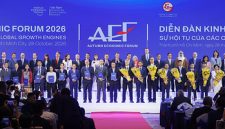
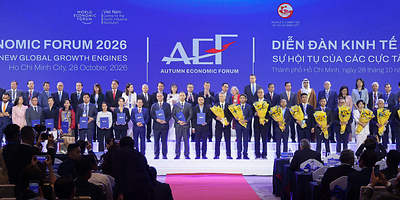
Prime Minister Le Minh Hung and delegates at the Autumn Economic Forum 2026.
Innovating cooperation to elevate economic standing
Taking place from October 26 to 29, 2026 in Ho Chi Minh City, the Autumn Economic Forum 2026 (AEF 2026), under the theme "Collaboration in a New Era", brings together over 1,800 delegates and 250 speakers from 60 countries and territories. Notably, the core activities on October 27 and 28, 2026, were co-branded by the Ho Chi Minh City People’s Committee and the World Economic Forum (WEF). Featuring 22 discussion sessions, alongside a series of investment promotion activities, business networking opportunities, and technology demonstrations, the Forum focused on identifying new models of collaboration and fresh driving forces for economic growth.
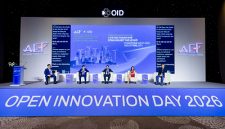
Running alongside the main programme, a series of side events co-organised with partners broadened the scope of collaboration at AEF 2026. On October 26, 2026, GRECO 2026, the 18th APRSCP Annual Roundtable, Open Innovation Day 2026 (OID 2026) and the Viet Nam – India Future Technology Forum focused on green growth, the twin digital and green transition and technology cooperation, setting the stage for the main sessions. On October 29, 2026, business forums and investment promotion seminars with partners from the UK, China, the Nordic countries and Israel carried this momentum forward, bringing the opportunities identified at the Forum closer to businesses and concrete projects.
During the dialogue session themed "Positioning Viet Nam in the Global Future" on October 28, in a discussion with Mr. Stephan Mergenthaler, Managing Director of the WEF, Prime Minister Le Minh Hung emphasized the need to shift from "investing in Viet Nam" to "investing together with Viet Nam". In this spirit, international corporations should not merely bring in capital, but also collaborate with Vietnamese enterprises to conduct research and develop technology, train human resources, and establish new value chains.
He highlighted three major challenges facing the global economy: international institutions failing to keep pace with rapid changes, the inherent limitations of traditional growth models, and a decline in strategic trust. In this context, a nation’s competitiveness depends not only on the size of its economy or its ability to attract capital, but also on its level of self-reliance, resilience, and capacity to generate new driving forces for growth.
Viet Nam possesses several advantages, including a strategic location in the Asia-Pacific region, a stable political and macroeconomic environment, a network of 18 free trade agreements, and a domestic market of over 100 million people. In the first nine months of 2026, the country’s GDP grew by 9.01%; registered foreign direct investment (FDI) reached $50.36 billion, an increase of 76.4%; and the total import-export turnover hit $987 billion, up by more than 30%.
However, attracting new capital is merely a necessary condition. To elevate its position within the global value chain, Viet Nam must transform its market and production advantages into capabilities for mastering technology, developing suppliers, and generating higher added value. Consequently, Prime Minister Le Minh Hung urged international corporations to strengthen ties with Vietnamese enterprises, research institutes, and universities, fostering long-term partnerships rather than focusing solely on expanding their investments and production operations.
From cooperation commitment to tangible results
The new cooperation framework is aligned with a target of achieving an average annual GDP growth of 10% or higher for the 2026–2030 period, with the vision of transforming Viet Nam into an emerging hub for digital technology, energy, and green agricultural production in both the region and the world by 2035.
To realize this goal, Prime Minister Le Minh Hung proposed four key priorities: fostering research and innovation partnerships between international corporations and Vietnamese enterprises; developing a high-tech workforce; establishing controlled regulatory sandboxes for AI and new energy technologies; and mobilizing medium- and long-term capital for development. In this context, the international financial centers in Ho Chi Minh City and Da Nang City are intended to connect global capital with projects in infrastructure, energy, and the green transition.
Viet Nam has identified three key approaches to enhancing its role in international cooperation: strengthening internal capacity, proactively proposing initiatives, and acting as a bridge on the basis of mutual trust and shared benefit. During a meeting with Mr. Stephan Mergenthaler on the sidelines of the Forum, Prime Minister Le Minh Hung requested that the WEF facilitate stronger connections between global corporations, investment funds, and Vietnamese enterprises, while affirming Viet Nam’s readiness to become a strategic partner of the WEF in the region.
Elaborating on this vision, Mr. Nguyen Van Duoc, Chairman of the Ho Chi Minh City People’s Committee, emphasized the goal of transforming Ho Chi Minh City into a hub for new growth engines, anchored by an International Financial Center, a Free Trade Zone, and a science and technology ecosystem. During the Forum, Ho Chi Minh City announced the first 10 members of the Viet Nam International Financial Center in Ho Chi Minh City (VIFC-HCMC), unveiled 12 projects with a total investment of approximately $16.4 billion, and announced a Joint Statement outlining the cooperation framework between the Ho Chi Minh City People’s Committee and the WEF. This Joint Statement aims to mobilize resources to support Ho Chi Minh City in achieving sustainable, double-digit growth, thereby contributing to the broader objective of expanding Viet Nam’s economy to a trillion-dollar scale, with a focus on four key resource areas: technology, capital, foreign direct investment (FDI), research and development (R&D) and knowledge.
Given its combined strengths in finance, industry, high technology, and a deep-water port system, Ho Chi Minh City is well-positioned to connect international capital with strategic projects, while fostering partnerships between domestic enterprises and global corporations. This marks a transition from merely showcasing potential to establishing concrete hubs for collaboration and specific projects.
Emphasizing the need to make cooperation substantive, Prime Minister Le Minh Hung affirmed that commitments must be translated into concrete mechanisms, viable projects, and measurable outcomes. He added that the Vietnamese Government would designate focal points, establish implementation roadmaps, and assign responsibilities for addressing investors’ proposals. The overarching spirit is a shift from coordination in implementation to strategic partnership, from seizing existing opportunities to creating new ones, and from sharing benefits to sharing responsibilities.
PR Newswire is the official media partner of Open Innovation Day 2026, which was co-organised within the framework of the Autumn Economic Forum 2026 by the Open Innovation and Technopreneur Institute (OITI); the National Academy for Advanced Technology and Innovation (NACENTECH) under the Ministry of Science and Technology of Viet Nam; Saigon Telecommunication & Technologies Corporation (SAIGONTEL); and the Viet Nam Centre for the Fourth Industrial Revolution in Ho Chi Minh City (HCMC C4IR), together with other co-organisers and partners.
Media Contact:
Nhung Nguyen – Communications Lead of AEF 2026
Email: ntnhung.c4ir@tphcm.gov.vn