






 |
"The State of Industrial Remote Access 2026" reveals rising vendor risk, visibility gaps, and accelerating shift toward unified OT access platforms
COPENHAGEN, Denmark, March 3, 2026 /PRNewswire/ — Industrial organizations worldwide are entering 2026 with growing confidence in their remote access security posture — but new research commissioned by Secomea shows that confidence often exceeds operational reality.
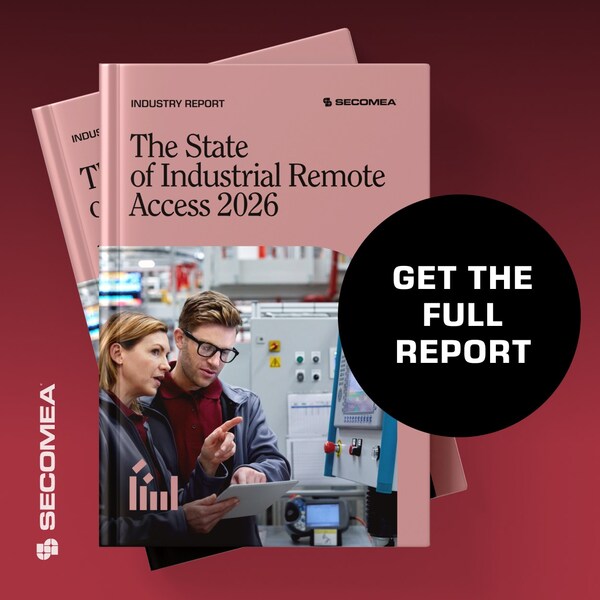
According to The State of Industrial Remote Access 2026 industry report[1], based on a global survey of 400 senior leaders across manufacturing and critical infrastructure, most organizations rate their session visibility and regulatory readiness as "good." However, deeper analysis reveals significant structural gaps in vendor oversight, credential hygiene, and auditability.
The report identifies a widening "confidence-to-evidence gap" in industrial cybersecurity: while compliance confidence rises quickly at moderate levels of visibility, full vendor session auditability remains uncommon.

The State of Industrial Remote Access 2026
Key Findings
Vendor access is the primary risk multiplier
As vendor ecosystems expand, incident likelihood rises sharply. Organizations managing 21–100 external vendors report the highest exposure levels. Risk concentrates where vendor session visibility is partial and credential reviews are infrequent.
Vendor-related risk, the report concludes, is not primarily driven by vendor behavior — but by how organizations structure and govern vendor access.
Partial vendor visibility is the global norm
Only 43% of organizations report full audit trails of vendor sessions. The majority operate with partial visibility, creating compliance and forensic blind spots.
Absence of vendor visibility correlates with universal incident exposure.
Zero trust adoption delivers measurable impact
Zero Trust depth shows a clear stepwise relationship with:
- Higher session visibility
- Improved vendor auditability
- Faster enablement speeds
- Reduced incident volatility
Organizations implementing all five core Zero Trust principles reach visibility levels not achieved through tooling alone.
Governance and IT/OT alignment predict outcomes
Nearly 70% of organizations now operate under shared IT/OT governance models — the structure most consistently associated with balanced security, operational speed, and auditability.
Where alignment weakens, vendor-related incident exposure nearly triples.
Tool fragmentation erodes control
Most organizations rely on multiple parallel access tools — VPNs, OEM utilities, PAM solutions, and emerging OT-dedicated platforms.
Session visibility declines measurably as tool stack complexity increases. Organizations using three or more remote access tools report lower visibility and higher friction than those operating consolidated environments.
Consolidation momentum is accelerating

The data shows a clear market shift toward identity-centric, unified OT remote access platforms.
Compared to non-users, organizations using OT-dedicated platforms report:
- Higher average session visibility
- Stronger full audit trail rates
- Lower incident exposure
- Faster vendor enablement
- Stronger IT/OT alignment
The report concludes that consolidation is not about replacing every legacy tool, but about governing access through a single operational control layer.
A structural shift, not a tactical upgrade
Remote access has evolved from a convenience tool to a strategic control surface for industrial operations.
As regulatory pressure intensifies and vendor ecosystems expand, the industry is converging toward:
- Federated vendor control models
- Shared IT/OT governance
- Identity-based access enforcement
- Time-bound, session-based permissions
- Unified auditability
The report describes this transition as a move from fragmented, reactive access to standardized, secure, policy-driven remote operations.
About the report
The State of Industrial Remote Access 2026 is based on a global survey of 400 OT, IT, compliance, and executive leaders across manufacturing and critical infrastructure sectors. The study examines architectural patterns, governance models, vendor access practices, Zero Trust adoption, regulatory alignment, and operational performance indicators.

About Secomea
Secomea is a Secure Remote Access (SRA) solution purpose-built for industrial networks and OT equipment. Over 8,000 customers worldwide rely on Secomea to manage secure remote access to their machines, prevent downtime, and strengthen cybersecurity across their global operations. For more than 15 years, Secomea has supported manufacturers and machine builders with a simple, scalable solution that bridges IT/OT requirements and provides the visibility, compliance, and control required to defend the factory floor.
1. https://secomea.com/guides/the-state-of-industrial-remote-access/.


Session visibility by tool category

Reported incident rate by tool stack complexity

Vendor session visibility by tool

Reported incident rate by vendor count


Zero trust adoption and incident rate